


How to Structure Retirement Income to Reduce Lifetime Taxes
Far too often, for many retirees, the biggest tax mistake isn’t how much they saved; it is how they withdraw their money (or take their distributions) and the sequence in which they take from their accounts.
Retirement income doesn’t come from a paycheck anymore. It often comes from multiple sources:
-
Traditional retirement accounts such as IRAs, SIMPLE IRAs, SEP IRAs, 457s, and 401(k)s
-
Roth IRAs
-
Brokerage accounts
-
Social Security
-
Pensions
- Rent
The order and timing of withdrawals can significantly impact:
-
Your tax bracket
-
Medicare premiums (IRMAA)
-
Taxation of Social Security
-
Required Minimum Distributions (RMDs)
-
Lifetime tax exposure
A strategic withdrawal plan may help improve tax efficiency over time. A structured approach, such as the Tax Bucket Strategy for Retirement Income, can help retirees organize accounts by tax treatment and make more informed withdrawal decisions.
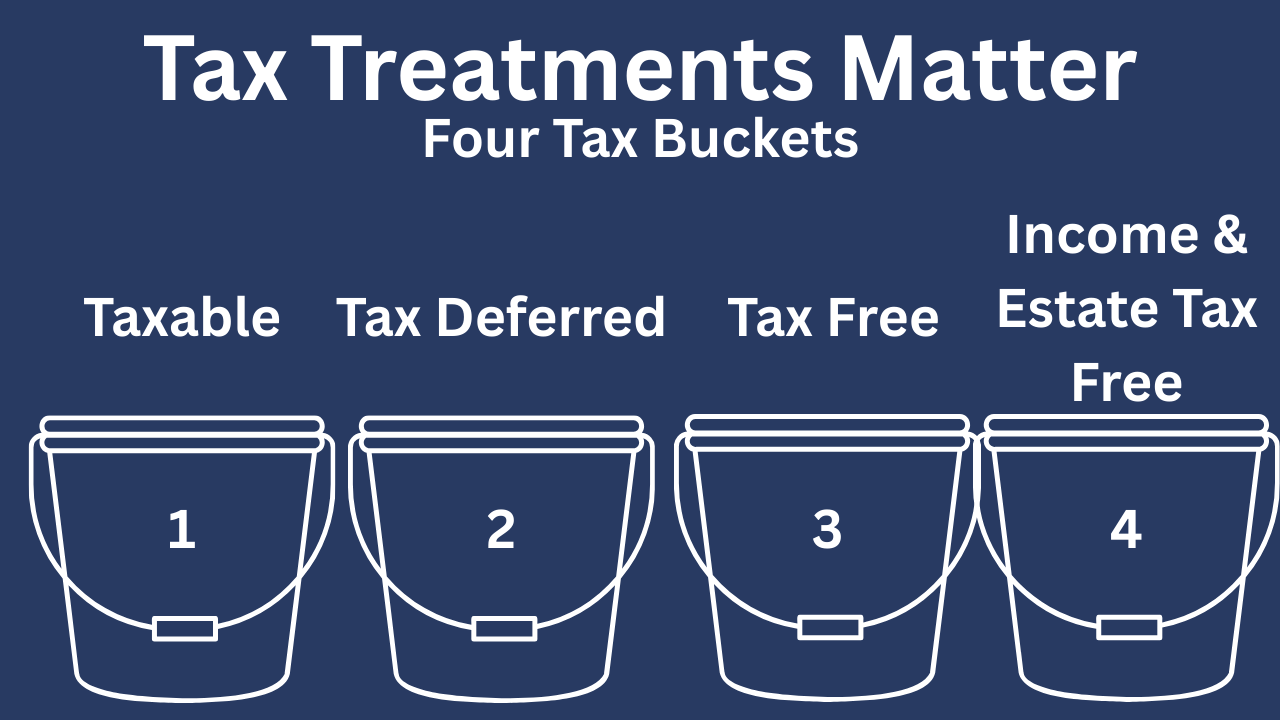
Understanding the Tax Buckets
Most retirees hold assets in three primary tax categories 1-3:
1. Tax-Deferred Accounts
Examples: Traditional IRA, 401(k)
Withdrawals are taxed as ordinary income.
Required Minimum Distributions (RMDs) generally begin at age 73 (for those turning 72 after 2022).
(Source: Internal Revenue Service, 2024, RMD rules)
2. Tax-Free Accounts
Examples: Roth IRA, Life Insurance
Qualified withdrawals are generally tax-free if IRS conditions are met.
(Source: IRS Publication 590-B)
3. Taxable Brokerage Accounts
Capital gains and dividends may be taxed differently from ordinary income.
The key question becomes: Which bucket should you pull from and when?
Common Withdrawal Strategies
1. Proportional Withdrawals
Taking money proportionally from each account each year.
This is a simple strategy, but not always tax-efficient.
2. Tax Bracket Management Strategy
Intentionally filling up lower tax brackets before moving into higher ones.
For example:
-
Withdrawing or converting funds while in a lower bracket
-
Managing income to avoid Medicare premium surcharges
Medicare Part B and D premiums are income-based (IRMAA adjustments).
(Source: Centers for Medicare & Medicaid Services, 2024)
3. Roth Conversion Strategy
Converting portions of traditional IRA funds into a Roth IRA during lower-income years.
This may:
-
Reduce future RMDs
-
Lower taxable income later in retirement
-
Reduce taxation of Social Security benefits
Taxation of Social Security benefits depends on provisional income.
(Source: Social Security Administration, 2024)
4. Delay Social Security While Using IRA Funds
Some retirees choose to:
-
Withdraw from IRAs early
-
Delay Social Security until age 70
-
Allow benefits to grow at delayed retirement credits
According to the Social Security Administration, benefits increase for each year delayed up to age 70.
(Source: SSA Benefits Planner, 2024)
It’s also important to consider your overall Safe Withdrawal Rate in Retirement, since withdrawing too aggressively early on can impact long-term sustainability.
Why Required Minimum Distributions Matter
RMDs can significantly increase taxable income later in retirement.
If large tax-deferred balances are left untouched, forced withdrawals may:
-
Push retirees into higher tax brackets
-
Increase Medicare premiums
-
Increase Social Security taxation
Proactive planning before RMD age can potentially reduce this impact.
(Source: IRS RMD guidance, 2024)
The Bigger Picture: Lifetime vs. Annual Taxes
Many retirees focus on minimizing taxes this year.
Strategic withdrawal planning focuses on minimizing taxes over your lifetime.
Sometimes that means:
-
Paying some tax earlier
-
Reducing tax later
-
Creating more predictable income streams
Every situation is unique, and coordination with a qualified tax professional is important before implementing any strategy. Market volatility can significantly impact retirement income, particularly during the early years, a concept known as Sequence of Returns Risk in Retirement.
Sources
Internal Revenue Service. (2024). Retirement plans FAQs regarding required minimum distributions. https://www.irs.gov/retirement-plans
Internal Revenue Service. (2024). Publication 590-B: Distributions from Individual Retirement Arrangements (IRAs). https://www.irs.gov/publications/p590b
Social Security Administration. (2024). Income taxes and your Social Security benefits. https://www.ssa.gov
Centers for Medicare & Medicaid Services. (2024). Medicare premiums and income-related monthly adjustment amounts (IRMAA). https://www.medicare.gov