


How the Tax Bucket Strategy for Retirement Income Can Improve Tax Efficiency
One of the most effective frameworks for structuring withdrawals is the Tax Bucket Strategy for Retirement Income.
Rather than viewing retirement savings as one large pool, this strategy separates assets into tax categories — or “buckets” — to improve long-term tax efficiency and income flexibility.
For retirees, understanding the Tax Bucket Strategy for Retirement Income may help:
-
Reduce lifetime tax exposure
-
Manage Required Minimum Distributions (RMDs)
-
Control Medicare premium thresholds
-
Improve income predictability
The Primary Tax Buckets
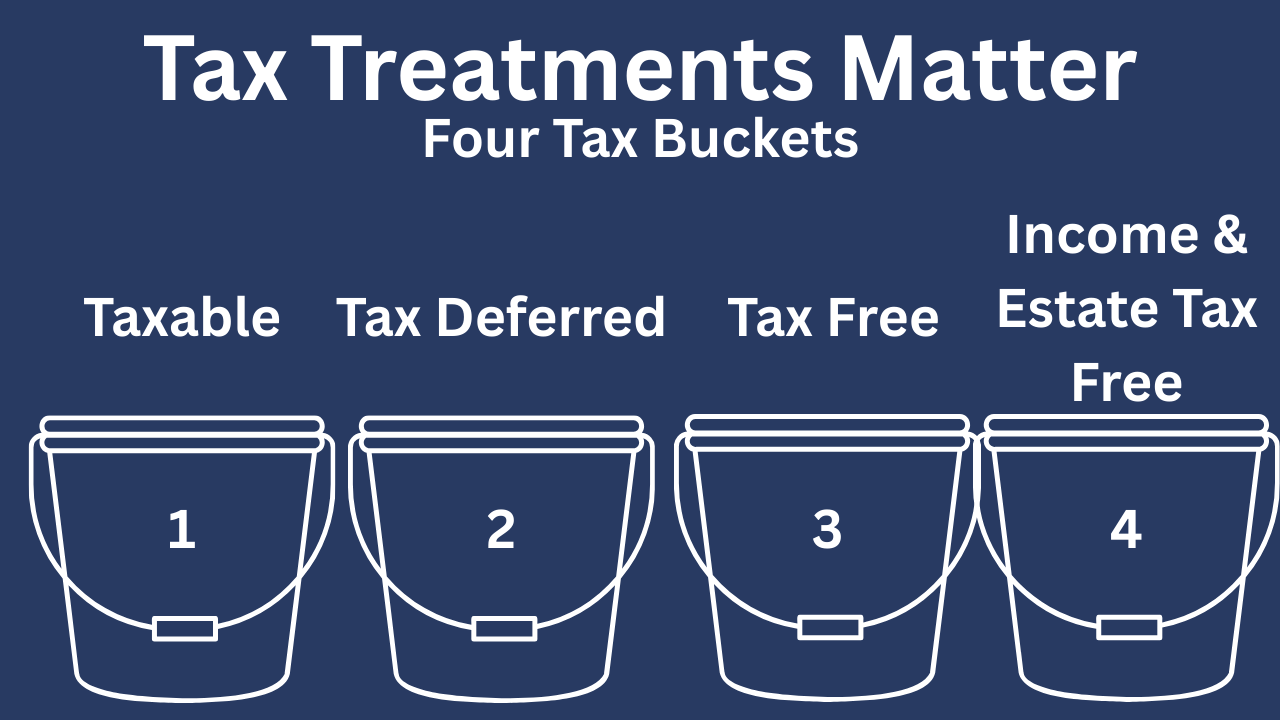

The Tax Bucket Strategy for Retirement Income generally divides assets into three categories:
1. Tax-Deferred Bucket
Examples:
-
Traditional IRA
-
401(k)
Withdrawals are taxed as ordinary income.
Required Minimum Distributions should begin at age 73 or earlier.
(Source: Internal Revenue Service, 2024 RMD Guidance)
2. Tax-Free Bucket
Examples:
-
Roth IRA
-
Roth 401(k)
- Life Insurance
Qualified withdrawals are generally tax-free if IRS requirements are met.
(Source: Internal Revenue Service Publication 590-B, 2024)
3. Taxable Bucket
Examples:
-
Brokerage accounts
-
Non-qualified investment accounts
Capital gains and qualified dividends may receive preferential tax treatment depending on income levels. This approach often complements broader retirement withdrawal strategies, especially when coordinating taxable and tax-deferred income sources.
Why the Tax Bucket Strategy for Retirement Income Matters
Without a plan, retirees often withdraw from accounts randomly or based on convenience. Understanding your Safe Withdrawal Rate in Retirement helps determine how much should come from each tax bucket annually.
However, withdrawal sequencing affects:
-
Federal income taxes
-
Social Security taxation
-
Medicare IRMAA thresholds
-
Future RMD amounts
The Tax Bucket Strategy for Retirement Income allows retirees to:
-
Fill lower tax brackets intentionally
-
Use taxable assets strategically
-
Preserve Roth assets for later years
-
Smooth taxable income over time
Coordinating Buckets With Social Security
Up to 85% of Social Security benefits may be taxable depending on provisional income.
By controlling which bucket income comes from, retirees may manage how much of their benefits are subject to taxation.
(Source: Social Security Administration, 2024)
Managing Medicare Premiums (IRMAA)
Medicare Part B and Part D premiums are income-based.
Large withdrawals from tax-deferred accounts may increase Modified Adjusted Gross Income (MAGI), potentially raising premiums two years later.
Using the Tax Bucket Strategy for Retirement Income may help smooth income and reduce unexpected premium increases.
(Source: Centers for Medicare & Medicaid Services, 2024)
Example of the Tax Bucket Strategy for Retirement Income
Imagine a retiree needs $80,000 annually:
-
Social Security covers $35,000
-
The remaining $45,000 is needed from investments
Instead of taking the full amount from a traditional IRA (which would increase taxable income), they might:
-
Take some from taxable accounts
-
Use strategic IRA withdrawals up to a bracket threshold
-
Preserve Roth funds for future flexibility
This approach may improve long-term tax efficiency.
Every situation is unique and should be reviewed with a qualified tax professional. Market downturns can impact bucket sequencing, particularly when considering Sequence of Returns Risk in Retirement.
Sources
Internal Revenue Service. (2024). Required minimum distributions. https://www.irs.gov
Internal Revenue Service. (2024). Publication 590-B: Distributions from IRAs. https://www.irs.gov
Social Security Administration. (2024). Income taxes and Social Security benefits. https://www.ssa.gov
Centers for Medicare & Medicaid Services. (2024). Medicare premiums and IRMAA adjustments. https://www.medicare.gov