
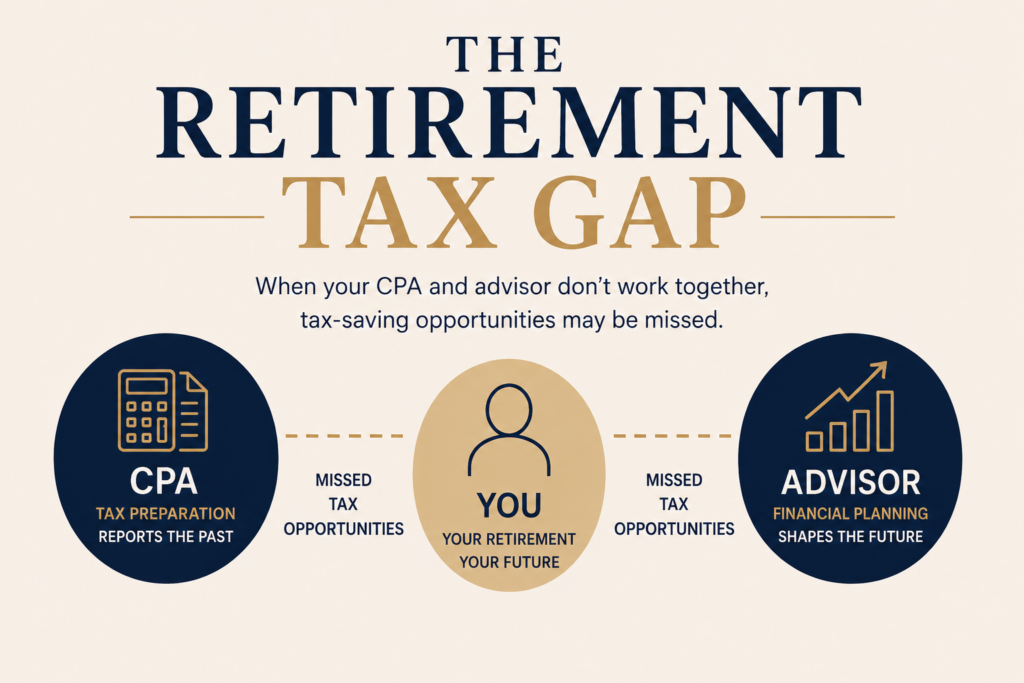
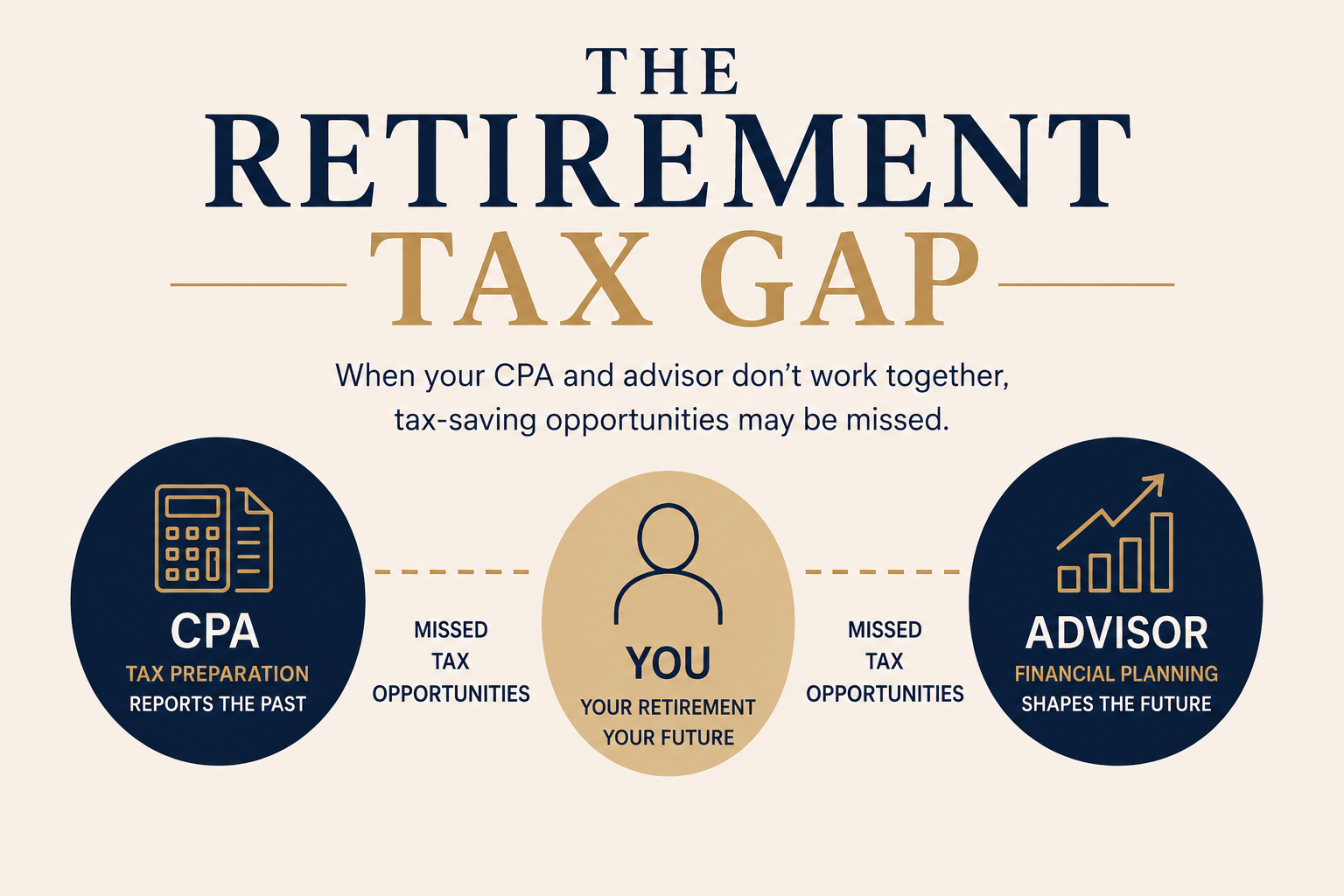
Tax Preparation Reports the Past. Tax Planning Helps Shape the Future.
When people retire, they often assemble an excellent team of professionals.
They may have:
- A trusted CPA
- A trusted financial advisor
- An estate planning attorney
- An insurance professional
Each plays an important role.
Yet despite having experienced professionals, many retirees unknowingly leave thousands of dollars on the table—not because someone made a mistake, but because no one is responsible for connecting all the pieces.
At Point Wealth Management, we call this The Retirement Tax Gap.
It is the space between tax preparation and proactive tax planning.
It is where many retirement planning opportunities are either discovered—or missed.
Tax Preparation and Tax Planning Are Not the Same
Many people use these terms interchangeably.
They shouldn’t.
A CPA’s role is often to accurately prepare and file your tax return based on what already happened during the year.
Tax planning asks a different question.
Instead of asking:
“What taxes do I owe?”
It asks:
“What decisions can I make today that may reduce taxes over the next 10, 20, or 30 years?”
Both are valuable.
But they serve different purposes.
Why Coordination Matters
Imagine this scenario.
Your CPA prepares your tax return in March.
Everything is accurate.
Nothing is wrong.
However…
During the previous year:
- You could have completed a partial Roth conversion.
- You may have reduced future Required Minimum Distributions.
- You may have avoided moving into a higher Medicare IRMAA bracket.
- You may have harvested capital gains while remaining in a favorable tax bracket.
- You may have coordinated charitable giving using a Qualified Charitable Distribution.
Unfortunately, by the time the tax return is prepared, those opportunities may already be gone.
That isn’t anyone’s fault.
It simply illustrates why communication throughout the year matters.
Where We See the Biggest Opportunities
Many retirement tax decisions don’t happen in April.
They happen before December 31.
Some of the most common opportunities include:
Roth Conversion Planning
Converting too much in one year could increase taxes.
Converting too little may leave future Required Minimum Distributions unnecessarily large.
Finding the appropriate balance requires planning.
Retirement Withdrawal Strategies
Should retirement income come from:
- Traditional IRA?
- Roth IRA?
- Taxable investment account?
The answer may change each year based on tax brackets and income.
Required Minimum Distributions
Waiting until your first RMD arrives often limits planning opportunities.
Preparing several years in advance can provide greater flexibility.
Medicare IRMAA Planning
Large withdrawals or Roth conversions can increase Medicare premiums two years later.
Understanding that relationship before making decisions can help avoid surprises.
Charitable Giving
Qualified Charitable Distributions may allow eligible retirees to satisfy Required Minimum Distributions while potentially lowering taxable income.
The Retirement Tax Gap Isn’t About Replacing Your CPA
This is an important distinction.
A CPA plays an essential role in your financial life.
Likewise, your financial advisor plays an essential role in helping manage investments, retirement income, and long-term financial goals.
The greatest value often comes when those professionals communicate and coordinate strategies.
Rather than working independently, each professional contributes expertise that can support more informed financial decisions.
A Real-World Example
Consider a retiree who plans to:
- Begin Social Security next year.
- Retire at age 65.
- Complete a Roth conversion.
- Sell appreciated investments.
- Make charitable donations.
- Begin Required Minimum Distributions in several years.
Each decision affects the others.
Looking at any one decision independently may overlook broader tax implications.
Looking at them together often creates more planning opportunities.
Point Wealth Insight
One of the most common situations we encounter is meeting retirees who have an outstanding CPA and an outstanding financial advisor.
The surprising part isn’t the quality of either professional—it’s that they rarely communicate with one another.
Retirement planning today involves much more than preparing a tax return or selecting investments. Decisions about Roth conversions, Required Minimum Distributions, Medicare premiums, Social Security, charitable giving, and retirement income are interconnected.
Our goal isn’t to replace your CPA. It’s to complement the work they do by helping identify planning opportunities throughout the year, then coordinating with your tax professional so everyone is working toward the same long-term objectives.
Ask the Advisor
No single professional has every answer.
The strongest retirement plans often result from collaboration among financial advisors, CPAs, attorneys, and, most importantly, the client.
If your retirement strategy hasn’t included regular coordination between your financial and tax professionals, it may be worth asking whether additional planning opportunities exist.
Sources
- Internal Revenue Service – Publications 17 and 590-B; retirement account and tax guidance.
- American Institute of Certified Public Accountants – Tax planning resources and CPA best practices.
- Certified Financial Planner Board of Standards – Financial planning standards and fiduciary guidance.
- Social Security Administration – Retirement benefits and taxation resources.