
Form 1040 Line 3a vs. Line 3b: One of the Most Overlooked Numbers on Your Tax Return
Why Retirees Should Understand Qualified Dividends
Why These Two Lines Matter
Every year millions of taxpayers file Form 1040 without ever noticing two small lines near the top of the return.
Line 3a
Line 3b
To most people, they’re just numbers.
To retirees, they can represent thousands of dollars in tax savings.
The goal isn’t necessarily to increase your dividend income.
The goal is to increase the percentage of your dividends that qualify for the lower long-term capital gains tax rates.
What’s the Difference?
Line 3b — Ordinary Dividends
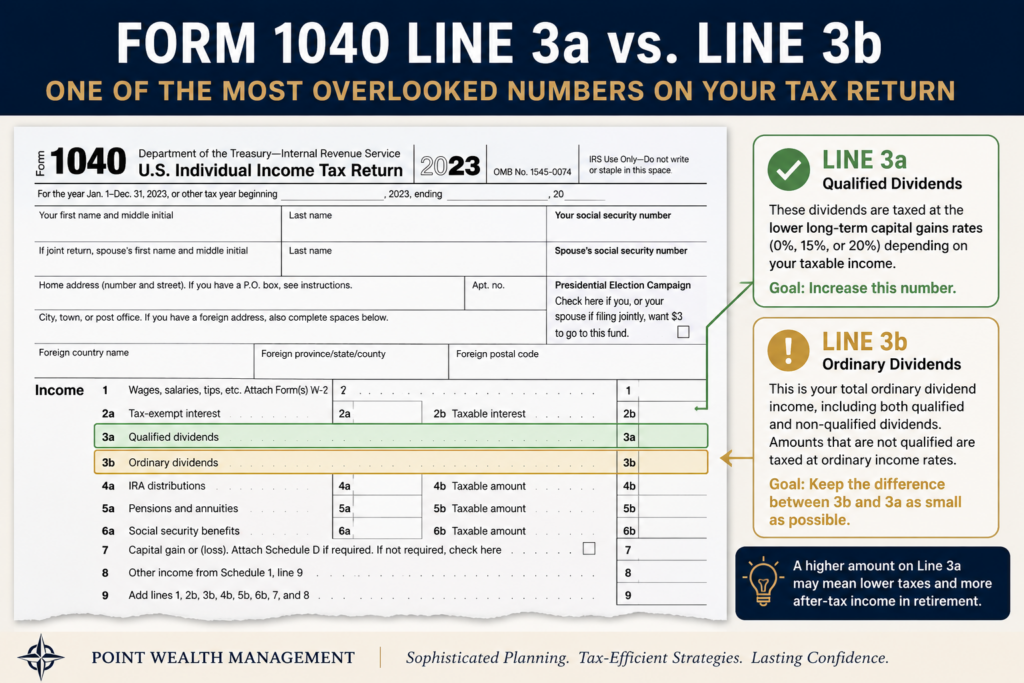
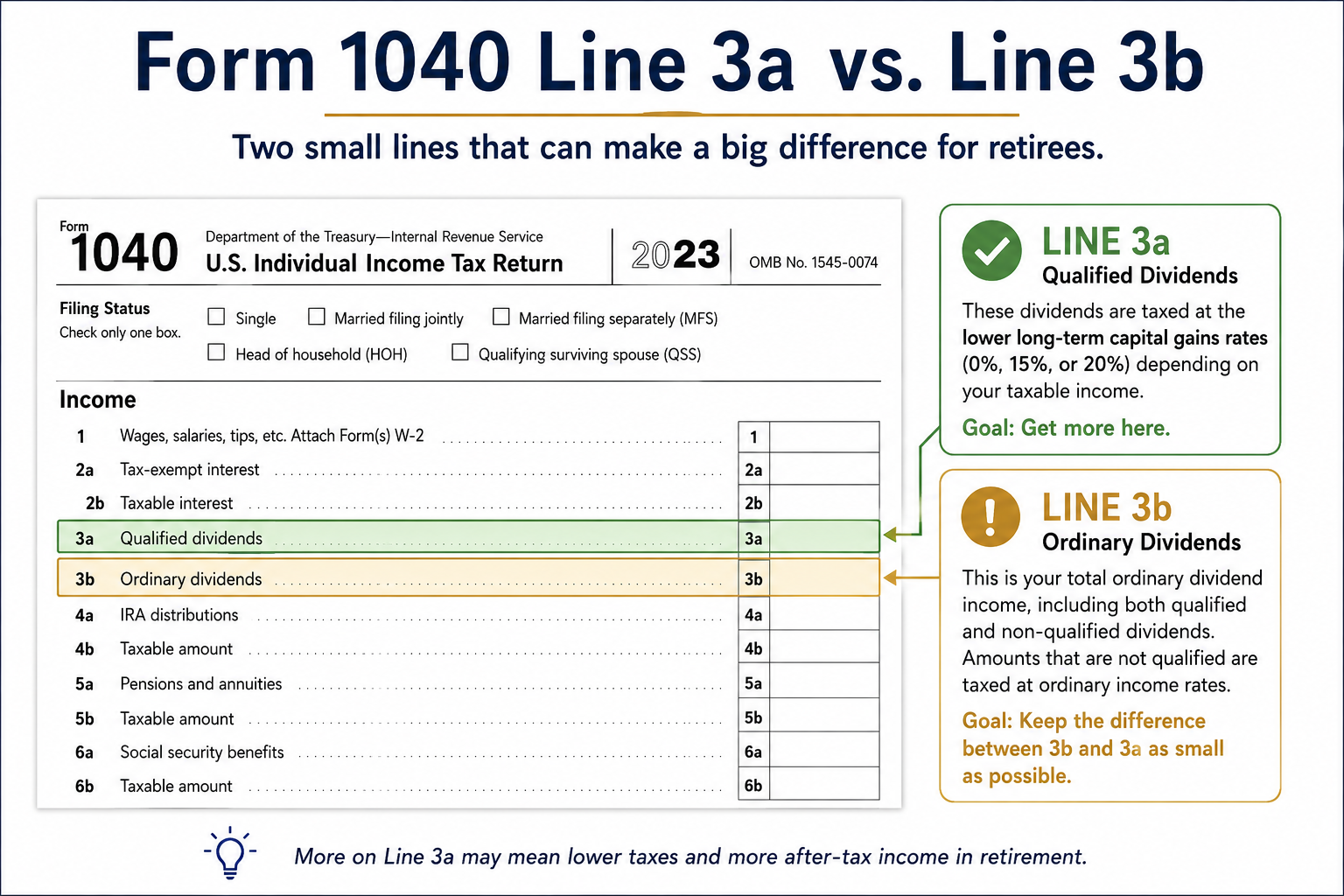
Line 3b reports all ordinary dividends you received during the year.
This includes:
- Qualified dividends
- Non-qualified dividends
Think of Line 3b as the total amount.
Line 3a — Qualified Dividends
Line 3a is a subset of Line 3b.
These dividends generally qualify for the favorable long-term capital gains tax rates rather than ordinary income tax rates.
If your tax return shows:
- Line 3b = $25,000
- Line 3a = $23,000
That means 92% of your dividend income received favorable tax treatment.
Why Qualified Dividends Matter
Qualified dividends are generally taxed at the same rates as long-term capital gains.
Depending on your taxable income, those rates may be:
- 0%
- 15%
- 20%
By comparison, non-qualified dividends are generally taxed as ordinary income.
For retirees in higher tax brackets, the difference can be substantial.
How Do You Get More Income on Line 3a?
You don’t change your tax return.
You change what you own.
Generally, qualified dividends come from:
- Most U.S. companies
- Many blue-chip dividend-paying stocks
- Many broad-market ETFs
- Some mutual funds (to the extent they distribute qualified dividends)
- Certain qualified foreign corporations
Income that often does not qualify includes:
- Money market funds
- Bond funds (interest is not a dividend)
- REIT dividends (with exceptions)
- Master Limited Partnerships (MLPs)
- Some foreign companies that do not meet IRS requirements
- Short holding periods that fail IRS rules
Holding Period Matters
Even if a company pays qualified dividends, you generally must satisfy the IRS holding-period requirements.
For most common stock, you must hold the shares for more than 60 days during the 121-day period surrounding the ex-dividend date.
Simply buying a stock right before the dividend is paid does not automatically make the dividend qualified.
Why This Matters for Retirees
Many retirees rely on investment income to supplement Social Security and IRA withdrawals.
If a larger portion of that income appears on Line 3a instead of being taxed as ordinary income, it may help:
- Lower federal income taxes
- Preserve more after-tax income
- Improve retirement cash flow
- Increase tax efficiency without increasing investment risk
Point Wealth Insight
Many investors focus on dividend yield.
We focus on after-tax dividend yield.
A 4% dividend is not necessarily better than a 3.5% dividend if much of the higher yield is taxed at ordinary income rates.
The amount you keep—not just the amount you earn—is what ultimately matters.
Ask the Advisor
The next time you review your tax return, don’t just look at your refund.
Compare Line 3a to Line 3b.
If there is a large difference, it may be worth reviewing whether your investment portfolio is generating the most tax-efficient income possible.
Continue Learning:
Sources
- Internal Revenue Service – Form 1040 Instructions.
- Internal Revenue Service – Publication 550: Investment Income and Expenses.
- U.S. Securities and Exchange Commission – Dividend investing guidance.