
Tax Diversification: Why Having Different Types of Retirement Accounts Matters
Building Tax Flexibility for Retirement
When most people hear the word “diversification,” they think about owning different investments.
Stocks.
Bonds.
International investments.
Real estate.
While investment diversification is important, there’s another form of diversification that often receives much less attention.
Tax diversification.
Instead of asking, “What should I own?”
Tax diversification asks:
“How will my retirement income be taxed?”
For many retirees, that answer may have just as much impact on long-term wealth as investment performance.
What Is Tax Diversification?
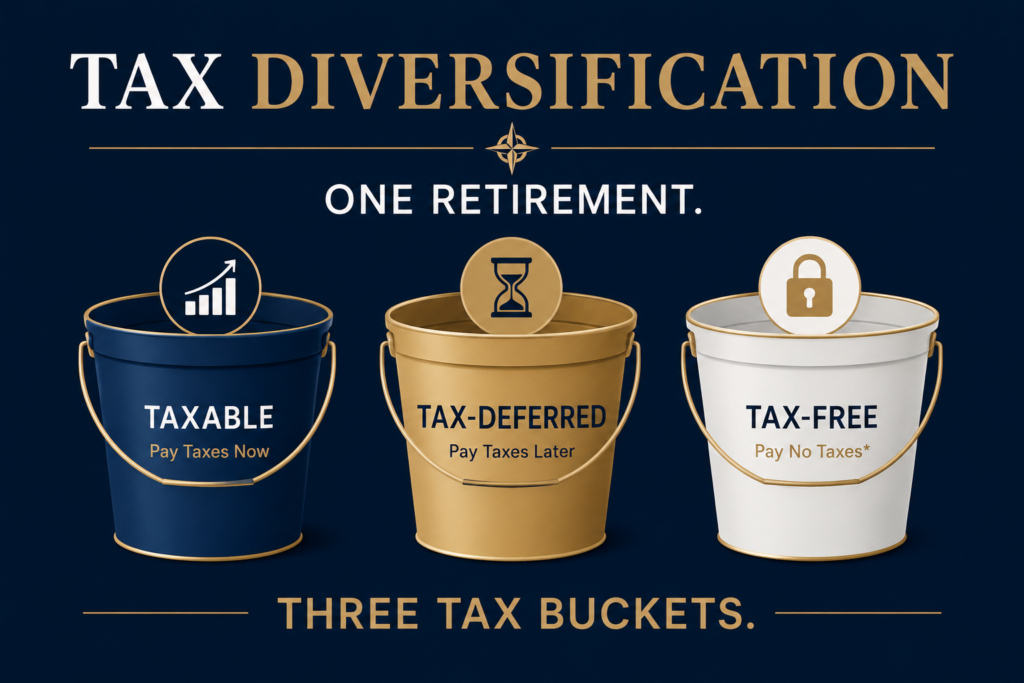
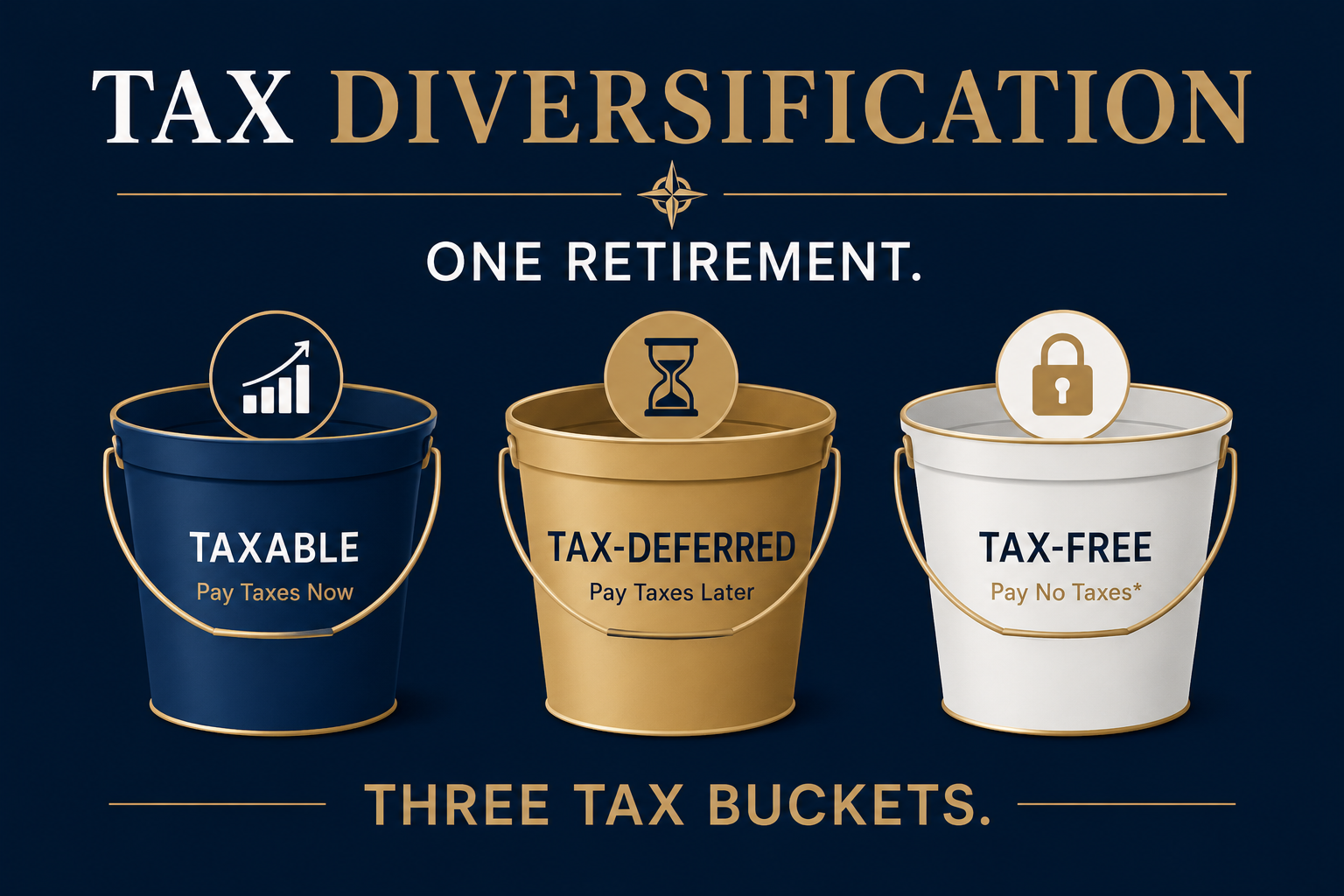
Tax diversification means accumulating retirement savings in accounts that receive different tax treatment.
Generally, these fall into three categories.
Taxable Accounts
Examples include:
- Brokerage accounts
- Bank savings
- CDs
Taxes may be due annually on interest, dividends, and realized capital gains.
Tax-Deferred Accounts
Examples include:
- Traditional IRA
- Traditional 401(k)
- 403(b)
Contributions may have reduced taxable income when made, but withdrawals are generally taxable as ordinary income.
These accounts are also generally subject to Required Minimum Distributions (RMDs).
Tax-Free Accounts
Examples include:
- Roth IRA
- Roth 401(k)
Qualified withdrawals are generally tax-free under current law.
Original Roth IRA owners are not subject to lifetime Required Minimum Distributions.
Why Tax Diversification Matters
Imagine two retirees.
Each has accumulated $2 million.
One retiree has all of the money inside a Traditional IRA.
The other has assets spread among:
- A taxable brokerage account
- A Traditional IRA
- A Roth IRA
Although both have the same total wealth, the second retiree may have significantly more flexibility when deciding where retirement income should come from.
That flexibility can become valuable when managing:
- Federal income taxes
- Medicare IRMAA premiums
- Social Security taxation
- Capital gains
- Estate planning
Tax Flexibility Creates Planning Opportunities
No one knows what future tax rates will be.
Likewise, no one knows what Congress may change over the next several decades.
Having multiple account types allows retirees to adapt.
Some years it may make sense to draw primarily from taxable accounts.
Other years may favor Traditional IRAs.
Still others may favor Roth assets.
The ability to choose is often one of the greatest benefits of tax diversification.
Common Mistakes
Saving Everything in One Account
Many investors accumulate most of their retirement savings inside tax-deferred accounts.
While those accounts provide valuable tax benefits during working years, relying on them exclusively may reduce flexibility later.
Ignoring Future RMDs
Large Traditional IRA balances often lead to larger Required Minimum Distributions.
Tax diversification may help reduce this concentration over time.
Forgetting Roth Opportunities
Partial Roth conversions during lower-income years may improve tax diversification for future retirement income.
How Tax Diversification Fits Into Retirement Planning
Tax diversification is not about avoiding taxes.
It’s about giving yourself options.
Retirees who have multiple sources of retirement income may have greater flexibility when responding to:
- Changes in tax law
- Unexpected expenses
- Market volatility
- Medicare premium changes
- Estate planning goals
Point Wealth Insight
One of the questions we ask clients is, “If you needed an extra $25,000 next year, where would it come from?”
The answer matters.
If every dollar comes from a Traditional IRA, the tax consequences may be very different than if withdrawals can be coordinated among taxable accounts, Roth accounts, and tax-deferred retirement savings.
Tax diversification doesn’t guarantee lower taxes every year, but it often creates more choices—and in retirement planning, flexibility is valuable.
Ask the Advisor
Diversification isn’t only about your investments.
It’s also about how your retirement income will be taxed.
Reviewing your account mix today may help identify opportunities to create greater flexibility for the years ahead.
Continue Learning
- Asset Location Strategy: Where You Hold Investments Can Be Just as Important as What You Own
- IRA Withdrawals Before Required Minimum Distributions Begin
- The Retirement Tax Gap: Why Your CPA and Financial Advisor Should Work Together
Sources
- Internal Revenue Service – Publications 590-A and 590-B (IRAs).
- Internal Revenue Service – Roth IRA guidance.
- Certified Financial Planner Board of Standards – Retirement planning principles.
- U.S. Securities and Exchange Commission – Investor education resources.