
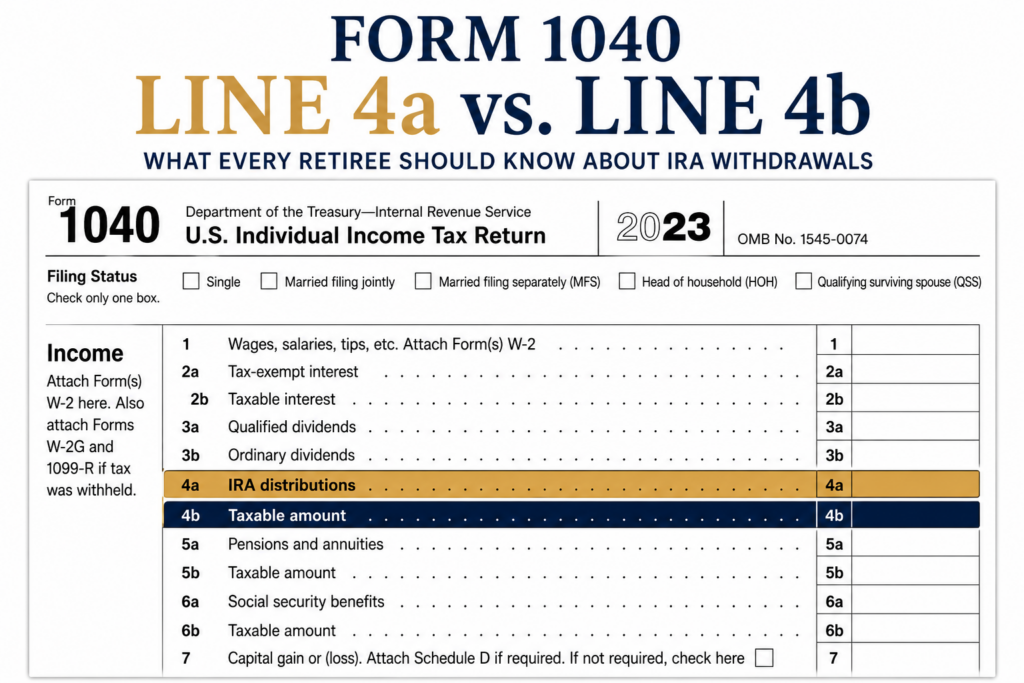
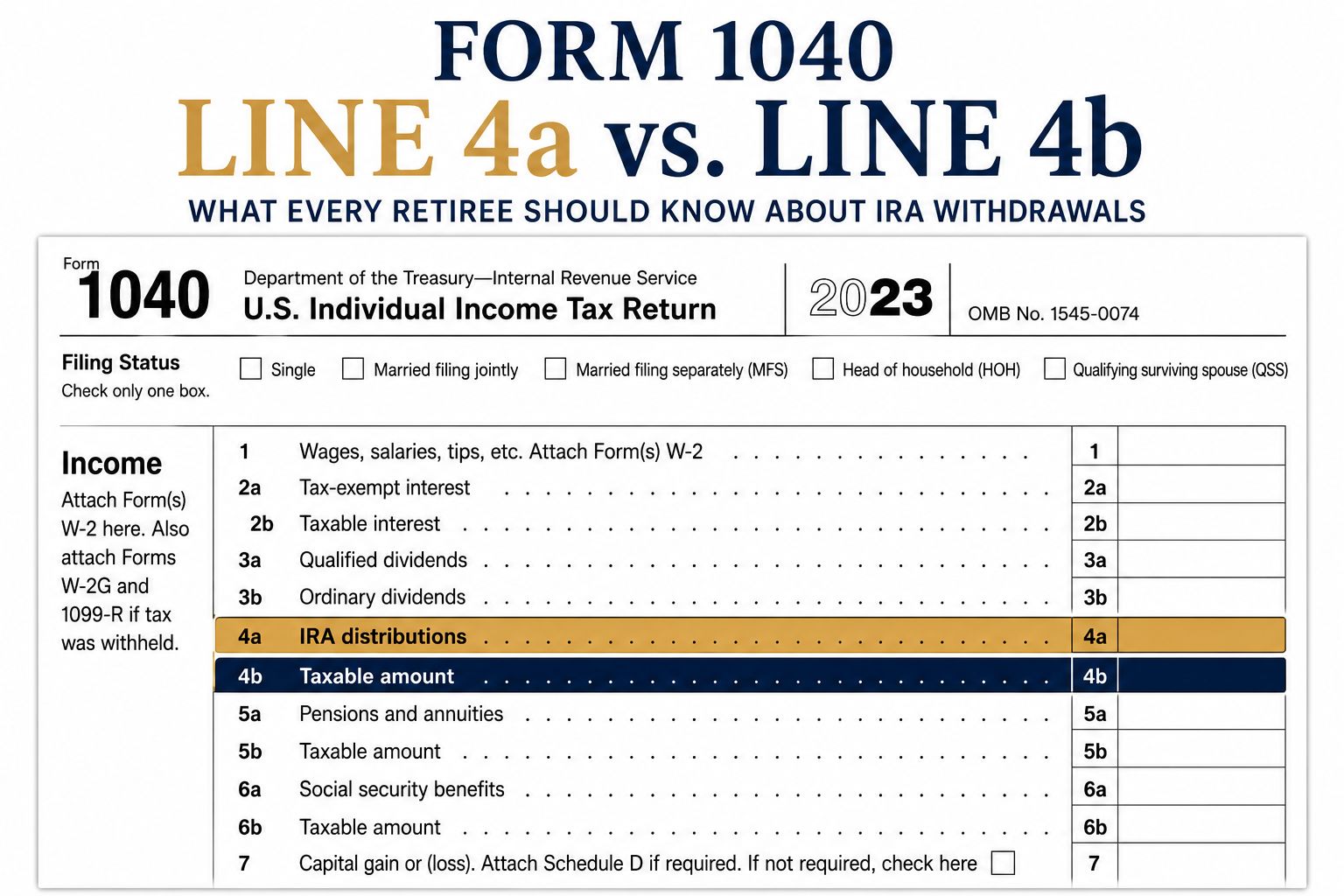
Form 1040 Line 4a vs. Line 4b: What Every Retiree Should Know About IRA Withdrawals
Understanding the Difference Between IRA Distributions and Taxable IRA Income
Why These Two Lines Matter
Most retirees focus on one number after filing their tax return:
“How much tax did I owe?”
But one of the most important planning opportunities appears much earlier on the return.
Lines 4a and 4b tell a story about how retirement income is being taxed.
Understanding the difference may help you recognize whether your retirement withdrawals are being managed efficiently.
What Is Line 4a?
Line 4a reports the total amount distributed from your IRAs during the year.
This may include:
- Traditional IRA withdrawals
- SEP IRA distributions
- SIMPLE IRA distributions
- 401(k) distributions
- Roth distributions
- Roth conversions
- Rollovers
- Qualified Charitable Distributions (although reporting rules vary)
What Is Line 4b?
Line 4b reports the portion of those distributions that is actually taxable.
In many cases:
- Line 4a = Line 4b
But not always.
Sometimes Line 4a may be much larger than Line 4b.
That difference often represents an opportunity—not a mistake.
Why Might Line 4a Be Higher Than Line 4b?
Several situations may create a difference.
Direct Rollovers
Suppose you rolled $500,000 from a 401(k) to a Traditional IRA.
Your tax return may show:
- Line 4a: $500,000
- Line 4b: $0
The money moved, but no tax was due because it was a direct rollover.
After-Tax IRA Contributions
If you previously made nondeductible IRA contributions, part of each withdrawal may represent a return of your after-tax basis.
Only the taxable portion appears on Line 4b.
Qualified Charitable Distributions (QCDs)
A Qualified Charitable Distribution may reduce the taxable amount reported on Line 4b because eligible amounts transferred directly to charity are generally excluded from taxable income.
Roth Conversions
A Roth conversion often causes both Line 4a and Line 4b to increase because the converted amount is generally taxable in the year of conversion (unless after-tax basis applies).
If you want to learn about Roth conversions and when they make sense.
Roth IRA/Roth 401(k) Distributions
When you make a distribution from the Roth IRA, assuming that the rules were followed, theoretically, the distribution will show up on line 4a and be zero for 4b.
Why Retirees Should Pay Attention
Many retirees assume all IRA withdrawals are taxed the same.
They aren’t.
The difference between Line 4a and Line 4b can reveal:
- Whether part of a distribution was tax-free
- Whether a rollover occurred
- Whether after-tax IRA basis is being recovered
- Whether charitable giving reduced taxable income
Reviewing these lines each year helps you understand how efficiently your retirement income is being taxed.
Point Wealth Insight
Many retirees celebrate a large IRA withdrawal because it provides spending money.
We ask a different question:
“How much of that withdrawal actually became taxable?”
The objective isn’t simply withdrawing money.
It’s maximizing the amount you keep after taxes.
That’s why we review the tax return—not just the investment statement.
Ask the Advisor
The next time you review your tax return, compare Line 4a and Line 4b.
If they’re identical, that’s normal for many retirees.
If they’re different, ask why. The answer may reveal planning opportunities that can improve your retirement tax strategy.
Continue Learning
- Form 1040 Line 3a vs. Line 3b: Why Qualified Dividends Matter
- Qualified Charitable Distributions (QCDs): One of Retirement’s Most Overlooked Tax Strategies
- IRA Withdrawals Before Required Minimum Distributions Begin
- Required Minimum Distributions: Common Mistakes and How to Avoid Them
- The Social Security Tax Torpedo
Sources
- Internal Revenue Service, 2025 Form 1040 Instructions (sections covering IRA distributions and Form 1040 Lines 4a and 4b).
- Internal Revenue Service, Publication 590-B: Distributions from Individual Retirement Arrangements (IRAs).
- Internal Revenue Service, Publication 575: Pension and Annuity Income.