
Form 1040 Line 6a vs. Line 6b: Why Some Retirees Pay Tax on Social Security
Understanding How Your Retirement Income Affects Social Security Taxes
What many retirees do not realize is that when Social Security was created in the USA under President Franklin D. Roosevelt in 1935, the average life expectancy was 58 for males and 62 for females. The government was essentially planning to provide for retirees for a much shorter time window than is happening with modern medical advances.
In short, Social Security will soon be paying out more than it receives. To counter this problem, the fed taxes Social Security to help offset people who have income over a certain threshold on their federal 1040s.
Many retirees assume Social Security is tax-free, and when it was originally made available in 1935 up until 1984, it was.
For some, it is not, but for many others, a portion of their Social Security benefits becomes taxable, depending on how much additional income they receive during retirement.
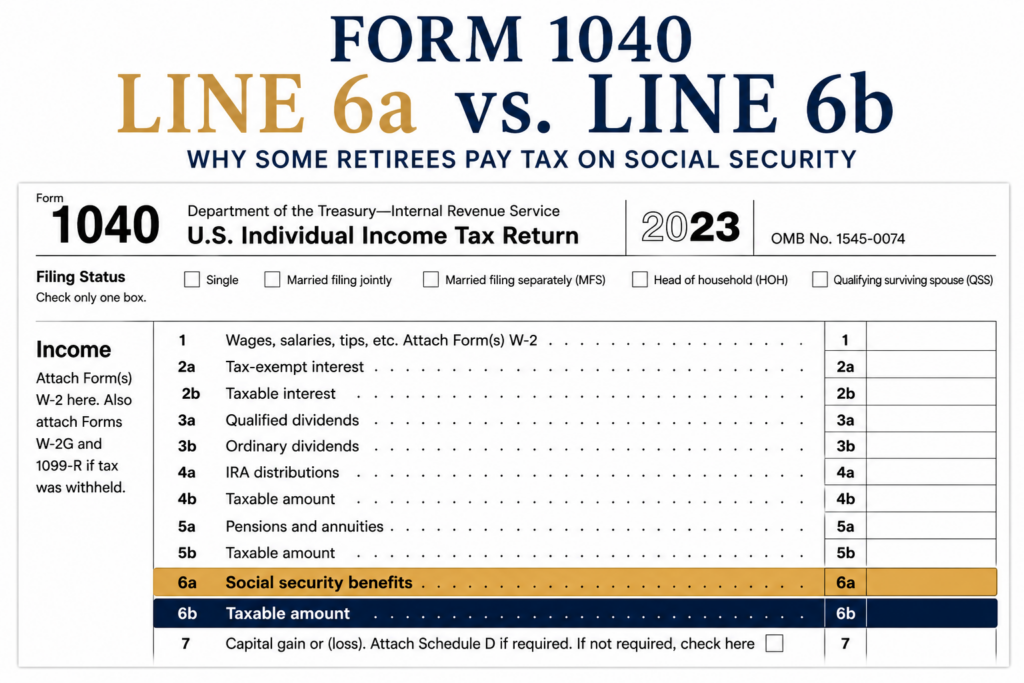
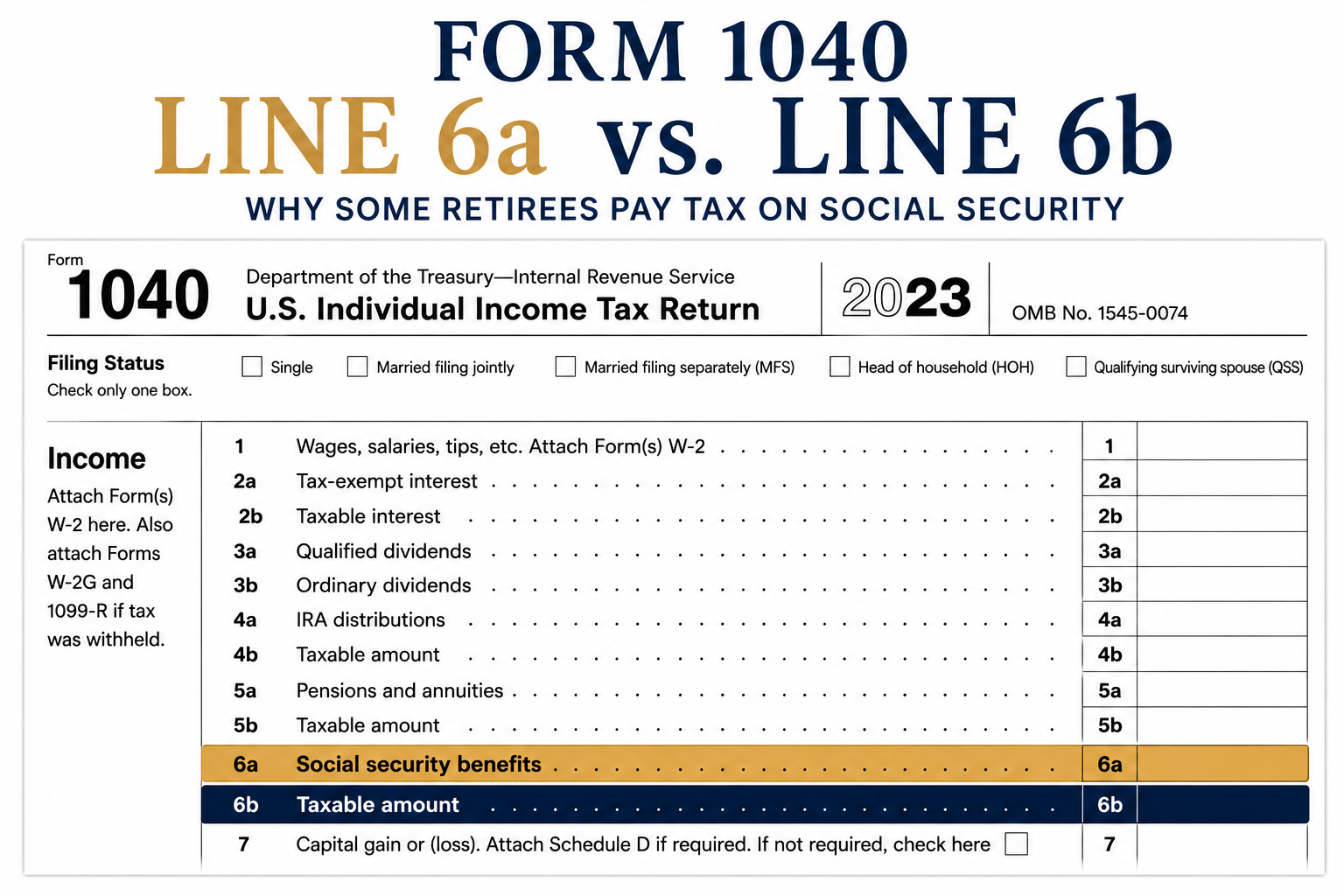
That’s why Line 6a and Line 6b on Form 1040 deserve attention every year.
Understanding these two lines may help you make more informed decisions about IRA withdrawals, Roth conversions, investment income, and Required Minimum Distributions.
What Is Line 6a?
Line 6a reports the total Social Security benefits you received during the year.
This is the gross amount before any portion is determined to be taxable.
Think of Line 6a as:
“How much Social Security did I receive?”
What Is Line 6b?
Line 6b reports the portion of your Social Security benefits that is included in your taxable income.
Depending on your income, that amount could be:
- $0
- Less than 50%
- Between 50% and 85%
- Up to 85% of your Social Security benefits
It’s important to note that this does not mean Social Security is taxed at an 85% tax rate. It means that up to 85% of your benefits may be included in your taxable income, where they are then taxed at your applicable tax rate.
Why Does Line 6b Increase?
The IRS uses a calculation called provisional income to determine how much of your Social Security is taxable.
Provisional income generally includes:
- IRA withdrawals
- Pension income
- Wages
- Taxable interest
- Tax-exempt municipal bond interest
- Capital gains
- One-half of your Social Security benefits
As provisional income increases, a larger portion of your Social Security benefits may become taxable.
A Simple Example
Suppose you receive:
- Social Security benefits: $40,000
- IRA withdrawals: $50,000
Your tax return may show:
- Line 6a: $40,000
- Line 6b: $34,000
In this example, 85% of your Social Security benefits are included in taxable income because your provisional income exceeds the applicable threshold.
Why Retirees Should Pay Attention
Line 6b isn’t just another number on your tax return.
It can tell you whether:
- IRA withdrawals are increasing your tax bill.
- Required Minimum Distributions are causing more Social Security to become taxable.
- Roth conversions should be timed differently.
- A different withdrawal strategy may improve tax efficiency.
Point Wealth Insight
Many retirees believe they only need to watch their tax bracket.
In reality, adding one dollar of IRA income may also cause additional Social Security benefits to become taxable.
That’s why retirement tax planning isn’t simply about minimizing taxes this year. It’s about understanding how different income sources interact over time.
Ask the Advisor
When reviewing your tax return, compare Line 6a with Line 6b.
If a large portion of your Social Security benefits is taxable, ask whether changes to your withdrawal strategy could improve your long-term tax picture.
Continue Learning
- The Social Security Tax Torpedo: Why One Extra Dollar Can Trigger a Much Bigger Tax Bill
- Form 1040 Line 4a vs. Line 4b: What Every Retiree Should Know About IRA Withdrawals
- IRA Withdrawals Before Required Minimum Distributions Begin
- Medicare IRMAA Explained
- Tax Diversification: Why Having Different Types of Retirement Accounts Matters
Sources
- Internal Revenue Service – Publication 915: Social Security and Equivalent Railroad Retirement Benefits.
- Internal Revenue Service – 2025 Form 1040 Instructions (Lines 6a and 6b).
- Social Security Administration – Information on benefit taxation and retirement income.