
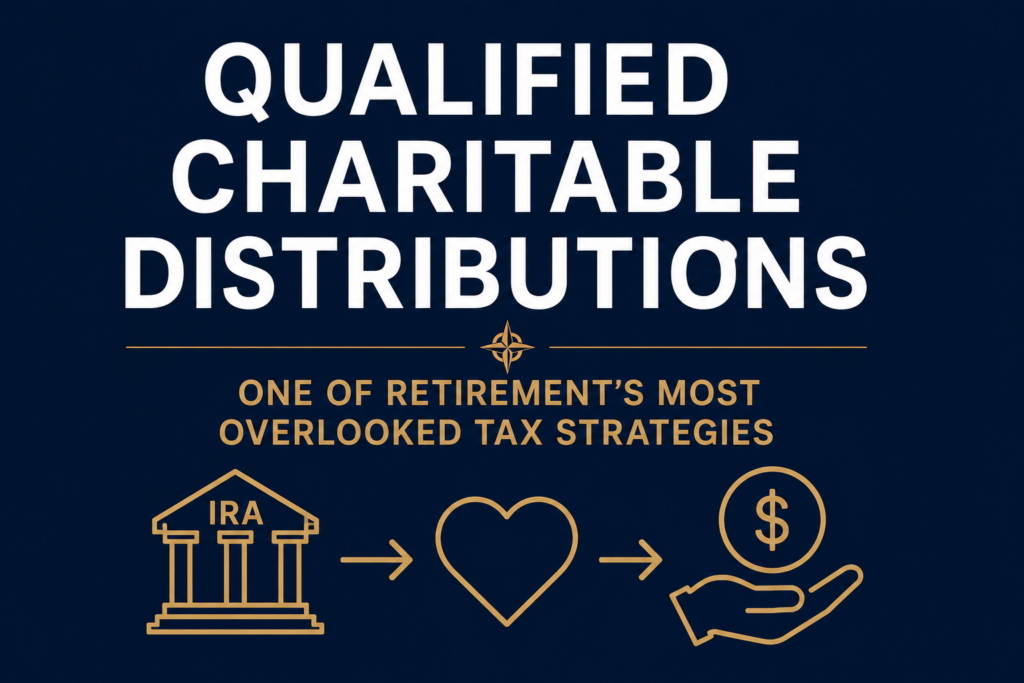
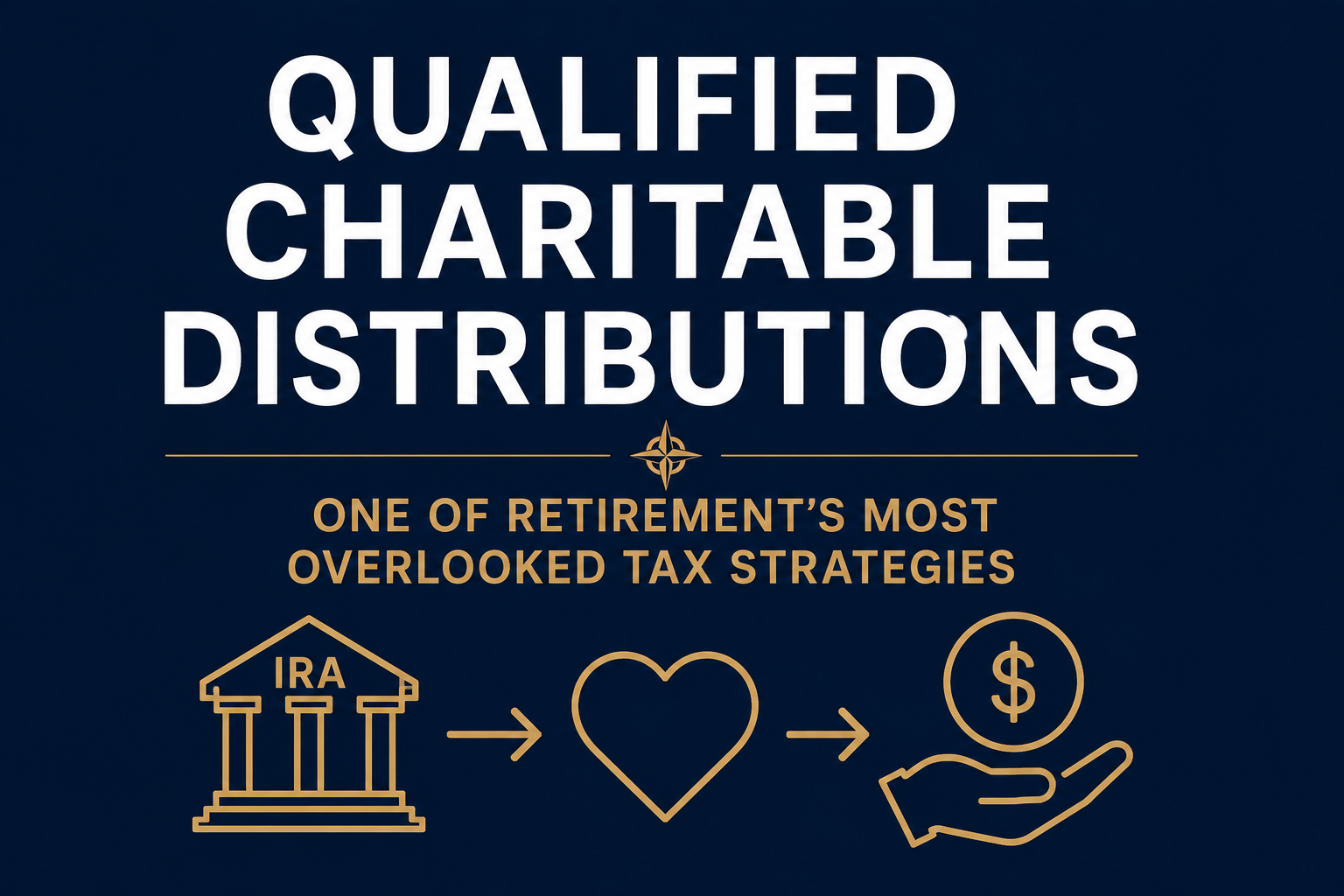
Qualified Charitable Distributions (QCDs): One of Retirement’s Most Overlooked Tax Strategies
How Giving Directly From Your IRA May Reduce Taxes While Supporting the Causes You Care About
Many retirees are charitable.
Every year they write checks to churches, schools, hospitals, and local nonprofits.
At the same time, many of those same retirees are required to take Required Minimum Distributions (RMDs) from their IRAs—and pay taxes on every dollar withdrawn.
Fortunately, the tax code offers a strategy that allows many retirees to accomplish both goals at once.
It’s called a Qualified Charitable Distribution, or QCD.
For retirees who already plan to give to charity, it can be one of the most tax-efficient strategies available.
What Is a Qualified Charitable Distribution?
A Qualified Charitable Distribution allows eligible IRA owners to transfer money directly from their IRA to a qualified charity.
Rather than receiving the money personally and then writing a check, the funds move directly from the IRA custodian to the charity.
When IRS requirements are met, the distribution is generally excluded from taxable income.
Who Can Use a QCD?
To qualify:
- You must be age 70½ or older.
- The distribution must come from an eligible IRA.
- The money must be sent directly to a qualified charitable organization.
- The charity must qualify under IRS rules.
Employer retirement plans generally must first be rolled into an eligible IRA before a QCD can be made.
Can a QCD Count Toward Your Required Minimum Distribution?
Yes.
Once Required Minimum Distributions begin, a Qualified Charitable Distribution can satisfy all or part of your annual RMD.
For example:
Suppose your Required Minimum Distribution is $18,000.
You normally donate $10,000 each year to your church.
Rather than taking the full $18,000 distribution and then writing a personal check, you could direct $10,000 from your IRA to the church as a Qualified Charitable Distribution.
Only the remaining $8,000 would generally be included in your taxable income.
Why a QCD Can Be Better Than a Charitable Deduction
Many retirees no longer itemize deductions.
As a result, writing a charitable check may provide little or no federal tax benefit.
A Qualified Charitable Distribution works differently.
Instead of claiming a deduction, the income generally never appears in your taxable income in the first place.
That difference may produce additional planning benefits.
Additional Benefits
Reducing taxable income may also help:
- Lower Medicare IRMAA premiums
- Reduce taxation of Social Security benefits
- Lower Adjusted Gross Income (AGI)
- Reduce exposure to certain tax phaseouts
The value of a QCD often extends well beyond simply satisfying an RMD.
Common Mistakes
Taking the RMD First
Once you receive your Required Minimum Distribution personally, you generally cannot later designate those same dollars as a QCD.
The transfer must occur directly from the IRA to the charity.
Writing a Personal Check
Receiving the funds first and then donating them generally does not qualify as a Qualified Charitable Distribution.
Giving to the Wrong Organization
Not every organization qualifies.
Certain donor-advised funds, private foundations, and supporting organizations generally do not qualify for QCD treatment.
Waiting Until December
Charities and custodians become busy late in the year.
Planning early helps ensure the transfer is completed before year-end.
Point Wealth Insight
Many retirees continue making charitable gifts exactly as they did during their working years—writing checks from their checking account.
Once Required Minimum Distributions begin, there may be a more tax-efficient approach.
For retirees who already plan to give, a Qualified Charitable Distribution may allow those gifts to reduce taxable income while satisfying part or all of an annual RMD. It’s one of the few strategies that can benefit both the retiree and the charity without requiring additional cash out of pocket.
Ask the Advisor
If charitable giving is already part of your retirement plan, ask whether your next donation should come directly from your IRA instead of your checking account.
A simple change in how the gift is made may improve your overall tax picture.
Continue Learning
- Required Minimum Distributions (RMDs): Common Mistakes and How to Avoid Them
- Medicare IRMAA Explained: Why Your Medicare Premiums May Suddenly Increase
- The Retirement Tax Gap: Why Your CPA and Financial Advisor Should Work Together
Sources
- Internal Revenue Service – Publication 590-B: Distributions from Individual Retirement Arrangements (IRAs).
- Internal Revenue Service – Qualified Charitable Distribution guidance.
- Internal Revenue Service – Required Minimum Distribution rules.
- National Council on Aging – Charitable giving and retirement planning resources.