
Why the Right Investments in the Right Accounts May Improve After-Tax Returns
When investors think about building a portfolio, they usually focus on one question:
“What should I invest in?”
While that’s certainly important, another question often receives much less attention:
“Where should I hold those investments?”
Surprisingly, the answer may have a meaningful impact on your long-term after-tax returns.
This concept is known as asset location.
Unlike asset allocation—which determines the percentage of stocks, bonds, and other investments you own—asset location focuses on placing investments into the accounts where they may be the most tax-efficient.
For retirees, this strategy can become an important part of long-term tax planning.
Asset Allocation vs. Asset Location
These two concepts are often confused.
Asset Allocation
Determines:
- Stocks
- Bonds
- Cash
- Alternatives
Asset Location
Determines:
- Taxable Brokerage Account
- Traditional IRA
- Roth IRA
- 401(k)
- Health Savings Account (HSA)
Think of it this way. Asset allocation builds the portfolio: where to save your next dollar. Asset location decides where each investment belongs.
Why Asset Location Matters
Not every investment is taxed the same way.
Some investments generate:
- Interest income
- Qualified dividends
- Ordinary dividends
- Capital gains
- Little current taxable income
Likewise, not every retirement account receives the same tax treatment.
For example:
A Roth IRA grows tax-free under current law.
A Traditional IRA generally grows tax-deferred.
A taxable brokerage account may generate annual taxable income.
Matching investments with the appropriate account type may improve after-tax outcomes over time.
A Simple Example
Imagine two investors who own the same investments.
Investor A randomly places investments across multiple accounts.
Investor B intentionally places:
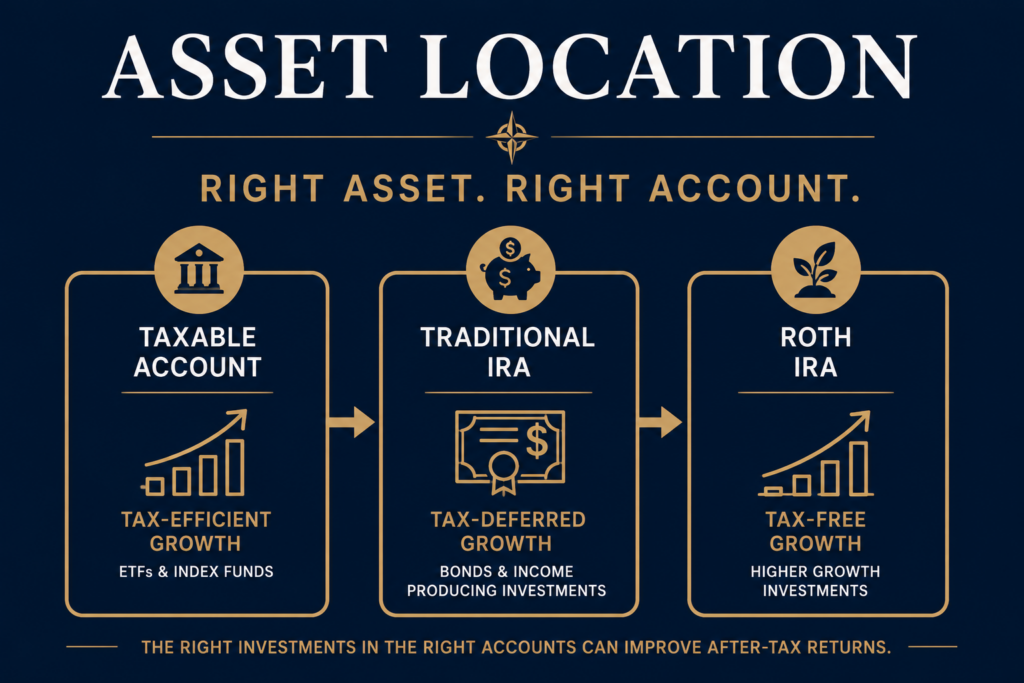
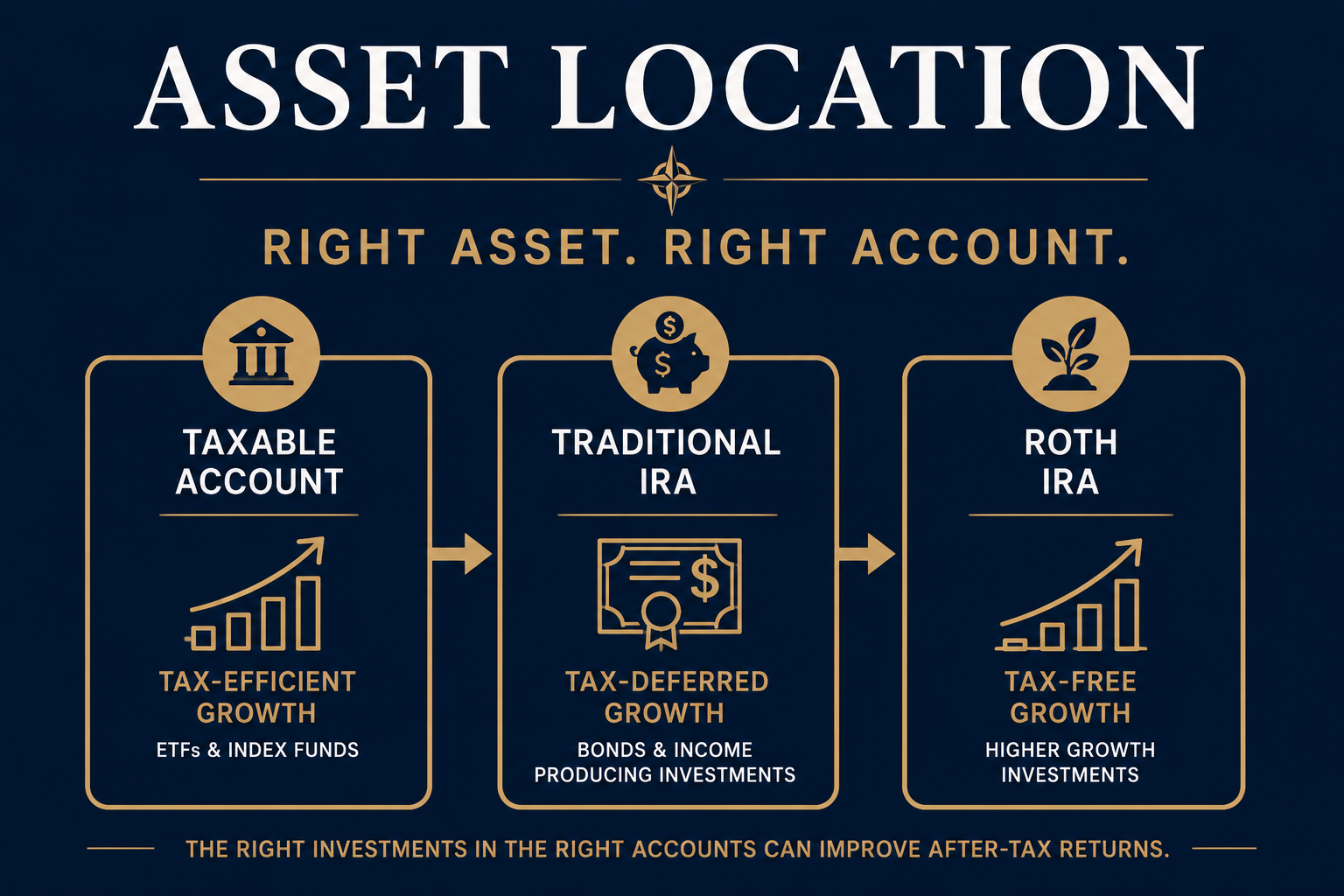
- Bond funds in tax-deferred accounts
- Broad stock index funds in taxable accounts
- Higher-growth investments in Roth IRAs
Years later, both portfolios may have earned similar investment returns.
However, Investor B may keep more after taxes simply because of where the investments were held.
Which Investments Often Belong in Which Accounts?
While every investor is unique, planners commonly evaluate strategies such as:
Taxable Brokerage Accounts
Often considered for:
Buy and hold strategies because of the taxes that could be generated short or long term capital gains.
- Broad stock ETFs
- Tax-efficient mutual funds
- Individual stocks held long-term
Traditional IRA
Often considered for:
- Bond funds
- REITs
- Higher-income-producing investments
Roth IRA
Often considered for:
- Investments with the greatest long-term growth potential
- Small-cap stocks
- Growth-oriented investments
The objective isn’t maximizing one account.
It’s maximizing your overall household after-tax wealth.
Common Mistakes
Treating Every Account the Same
Each account has different tax rules. Ignoring those differences may reduce long-term tax efficiency.
Focusing Only on Returns
Higher returns don’t necessarily translate into higher after-tax wealth. Taxes do matter.
Forgetting Future Withdrawals
Traditional IRAs eventually produce Required Minimum Distributions. Roth IRAs currently do not for the original owner. That difference often affects long-term planning.
Why Asset Location Matters During Retirement
As retirees begin drawing income from multiple accounts, thoughtful asset location may:
- Improve tax flexibility.
- Reduce Required Minimum Distributions.
- Create more efficient withdrawal strategies.
- Improve estate planning outcomes.
- Increase the amount ultimately retained after taxes.
Point Wealth Insight
Many investors spend years selecting investments while giving little thought to where those investments are actually held.
In our experience, asset location is one of the quieter contributors to long-term success. It rarely generates headlines, but over decades it can influence taxes, retirement income flexibility, and the amount ultimately passed on to beneficiaries.
Just as retirement planning isn’t about a single investment, tax efficiency isn’t about a single account. The greatest benefit often comes when every account serves a distinct purpose within an overall financial plan.
Ask the Advisor
If you have investments spread across multiple IRAs, Roth IRAs, 401(k)s, and taxable brokerage accounts, it may be worthwhile to review whether those investments are located in the most tax-efficient accounts—not just whether they’re appropriate investments.
Continue Learning
- Capital Gains in Retirement: How to Sell Investments Without Paying More Tax Than Necessary
- Tax-Loss Harvesting: A Smart Way to Reduce Investment Taxes
- The Retirement Tax Gap: Why Your CPA and Financial Advisor Should Work Together
Sources
- Internal Revenue Service – Publications 550 and 590-B.
- Bogleheads Foundation – Educational resources on tax-efficient investing and asset location.
- U.S. Securities and Exchange Commission – Investor education resources.
- Certified Financial Planner Board of Standards – Financial planning best practices.