
Net Unrealized Appreciation (NUA): A Little-Known Tax Strategy for Company Stock in Your 401(k)
How Highly Appreciated Company Stock May Qualify for More Favorable Tax Treatment
Many employees spend decades building retirement savings through their employer’s 401(k) plan. Along the way, they may also accumulate company stock inside that account.
When retirement approaches, most people assume the only option is to roll everything into an IRA. For many investors, that’s the right decision.
However, if your 401(k) contains highly appreciated employer stock, rolling it into an IRA without first evaluating the Net Unrealized Appreciation (NUA) rules could result in paying more taxes than necessary.
Although NUA isn’t appropriate for everyone, it can be one of the most valuable retirement tax strategies available to employees with significant company stock.
What Is Net Unrealized Appreciation (NUA)?
Net unrealized appreciation is a special tax rule that applies to appreciated employer stock held inside a qualified retirement plan.
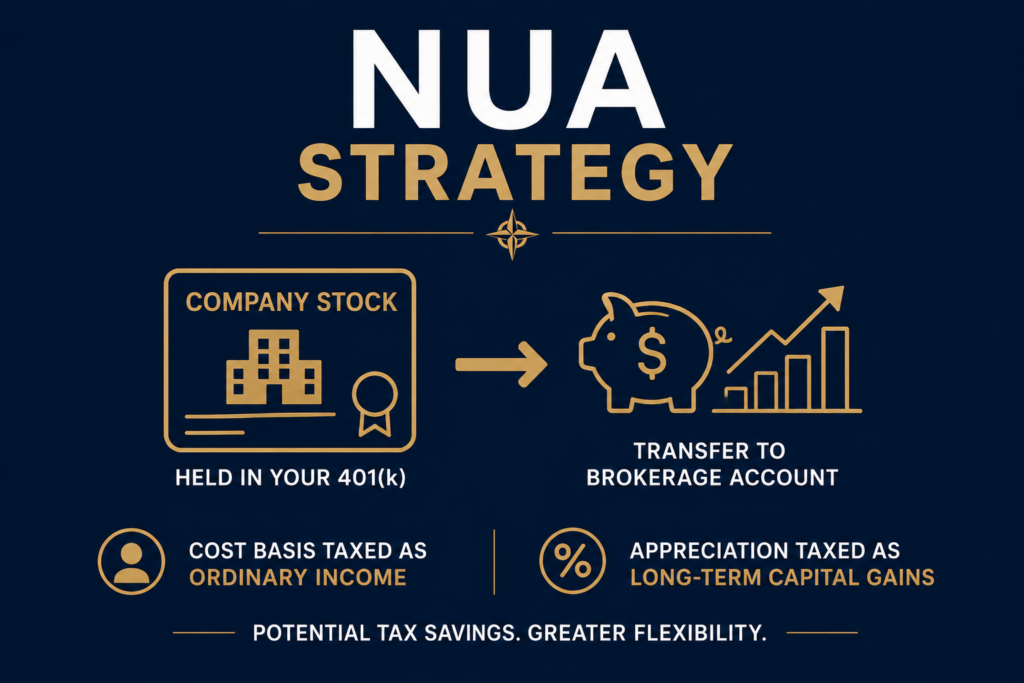
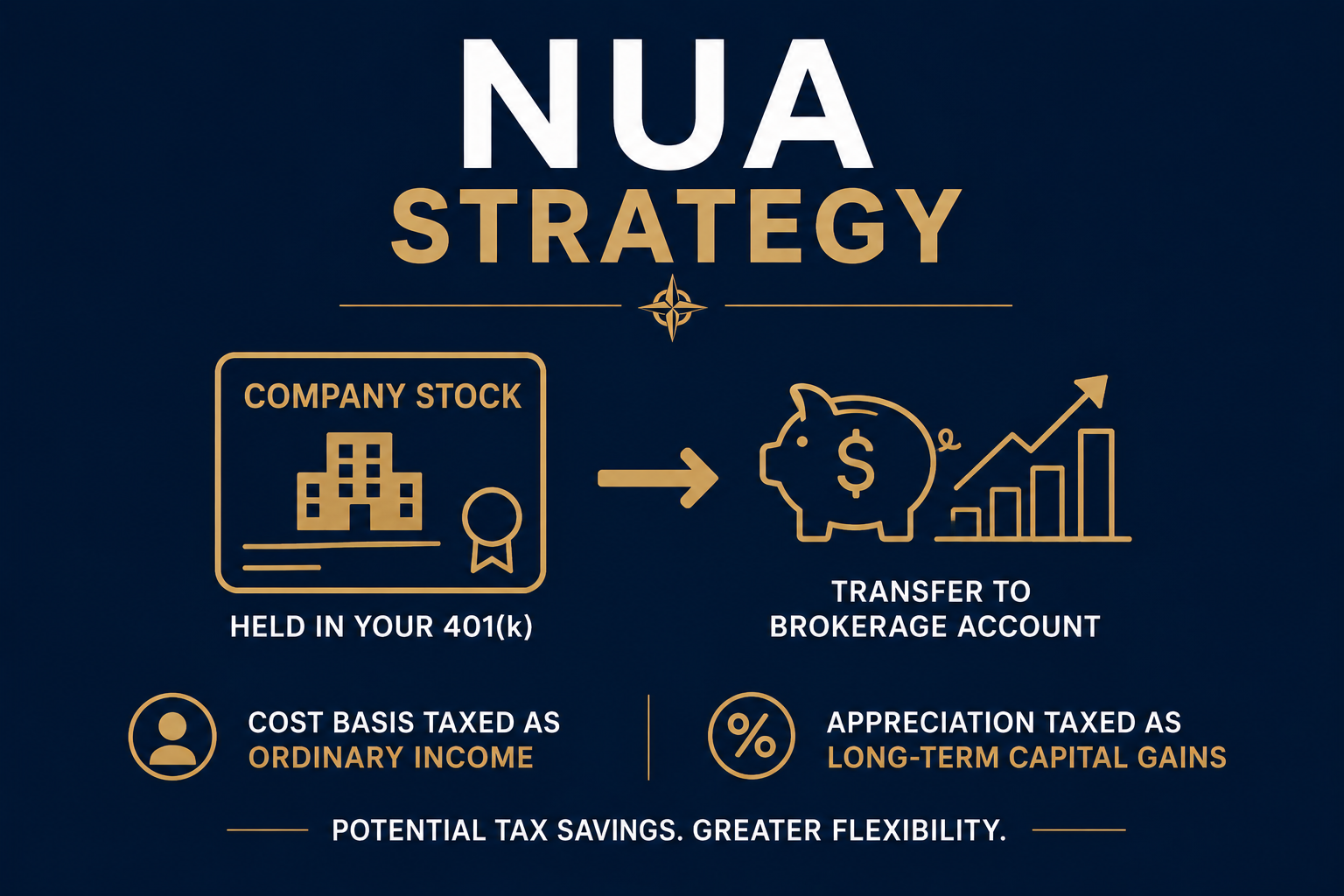
Instead of paying ordinary income taxes on the entire value of the stock when it’s eventually distributed from an IRA, the NUA rules may allow the appreciation above the original cost basis to be taxed at long-term capital gains rates when the stock is sold.
Because long-term capital gains rates are often lower than ordinary income tax rates, the potential tax savings can be significant.
A Simple Example
Suppose you accumulated employer stock inside your 401(k).
- Original cost basis: $100,000
- Current value: $500,000
If you simply roll the stock into an IRA and later withdraw it, the entire withdrawal is generally taxed as ordinary income.
With an NUA strategy, the tax treatment may look different:
- The $100,000 cost basis is generally taxed as ordinary income when distributed.
- The $400,000 of appreciation may qualify for long-term capital gains treatment when the stock is eventually sold.
Depending on your tax bracket, this difference can result in substantial tax savings.
Who Might Benefit?
An NUA strategy is most commonly evaluated when:
- A significant portion of a retirement account consists of employer stock.
- The employer stock has appreciated substantially.
- Retirement or separation from service is approaching.
- The investor plans to diversify the concentrated stock position.
The larger the appreciation, the greater the potential benefit.
Important IRS Requirements
NUA is governed by very specific IRS rules.
Among other requirements:
- The stock must be employer stock held inside a qualified retirement plan.
- A qualifying triggering event generally must occur (such as retirement, separation from service after a specified age, disability in some cases, or death).
- The distribution generally must qualify as a lump-sum distribution under IRS rules.
- Timing and execution are critical.
Because these rules are complex, professional guidance is essential before taking action.
Advantages of an NUA Strategy
Potential benefits include:
- Lower lifetime taxes.
- Long-term capital gains treatment on appreciation.
- Greater flexibility when selling shares.
- Opportunity to diversify concentrated company stock holdings.
Potential Disadvantages
NUA isn’t automatically the best choice.
Potential drawbacks include:
- Immediate ordinary income tax on the stock’s cost basis.
- Market risk after the shares leave the retirement plan.
- Loss of tax-deferred growth on future appreciation.
- More complex tax reporting.
Each situation should be evaluated individually.
Common Mistakes
Rolling the Entire 401(k) Into an IRA Without Reviewing NUA
Once employer stock is rolled into an IRA, the opportunity to use the NUA strategy is generally lost.
Waiting Too Long
Many employees don’t learn about NUA until after retirement paperwork has already been completed.
At that point, options may be limited.
Ignoring Concentration Risk
Even if NUA provides tax advantages, holding too much of a single company’s stock may increase portfolio risk.
Taxes are only one part of the decision.
Point Wealth Insight
One of the most expensive retirement planning mistakes isn’t making the wrong investment—it’s missing a tax strategy that only has one opportunity to be used.
Net Unrealized Appreciation is a good example. For retirees with substantial employer stock, evaluating this strategy before rolling assets into an IRA may create meaningful tax savings. However, once the rollover is complete, the opportunity is generally gone.
This illustrates why retirement planning decisions should be coordinated before paperwork is signed rather than after.
Ask the Advisor
If your 401(k) includes employer stock, don’t assume a full IRA rollover is automatically the best option.
Before making any distribution decisions, ask whether a Net Unrealized Appreciation analysis should be part of your retirement plan.
Continue Learning
- Capital Gains in Retirement: How to Sell Investments Without Paying More Tax Than Necessary
- The Retirement Tax Gap: Why Your CPA and Financial Advisor Should Work Together
- Tax Diversification: Why Having Different Types of Retirement Accounts Matters
Sources
- Internal Revenue Service – Publication 575: Pension and Annuity Income (NUA rules).
- Internal Revenue Service – Publication 559 and retirement distribution guidance.
- U.S. Securities and Exchange Commission – Investor education on employer stock concentration risk.
- Financial Industry Regulatory Authority – Employer stock and retirement account considerations.