
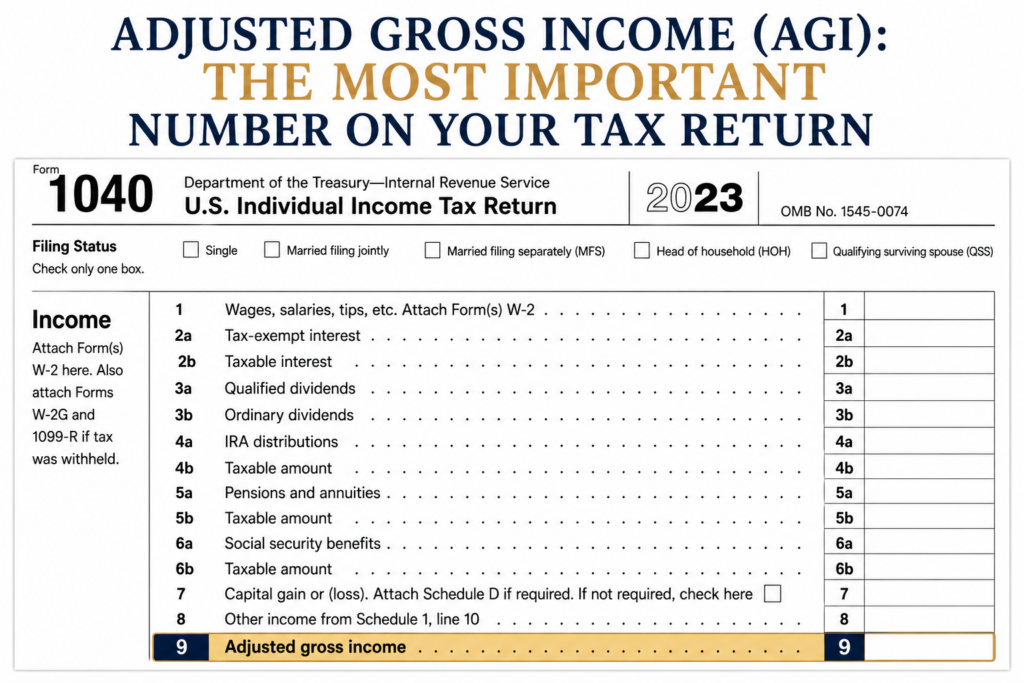
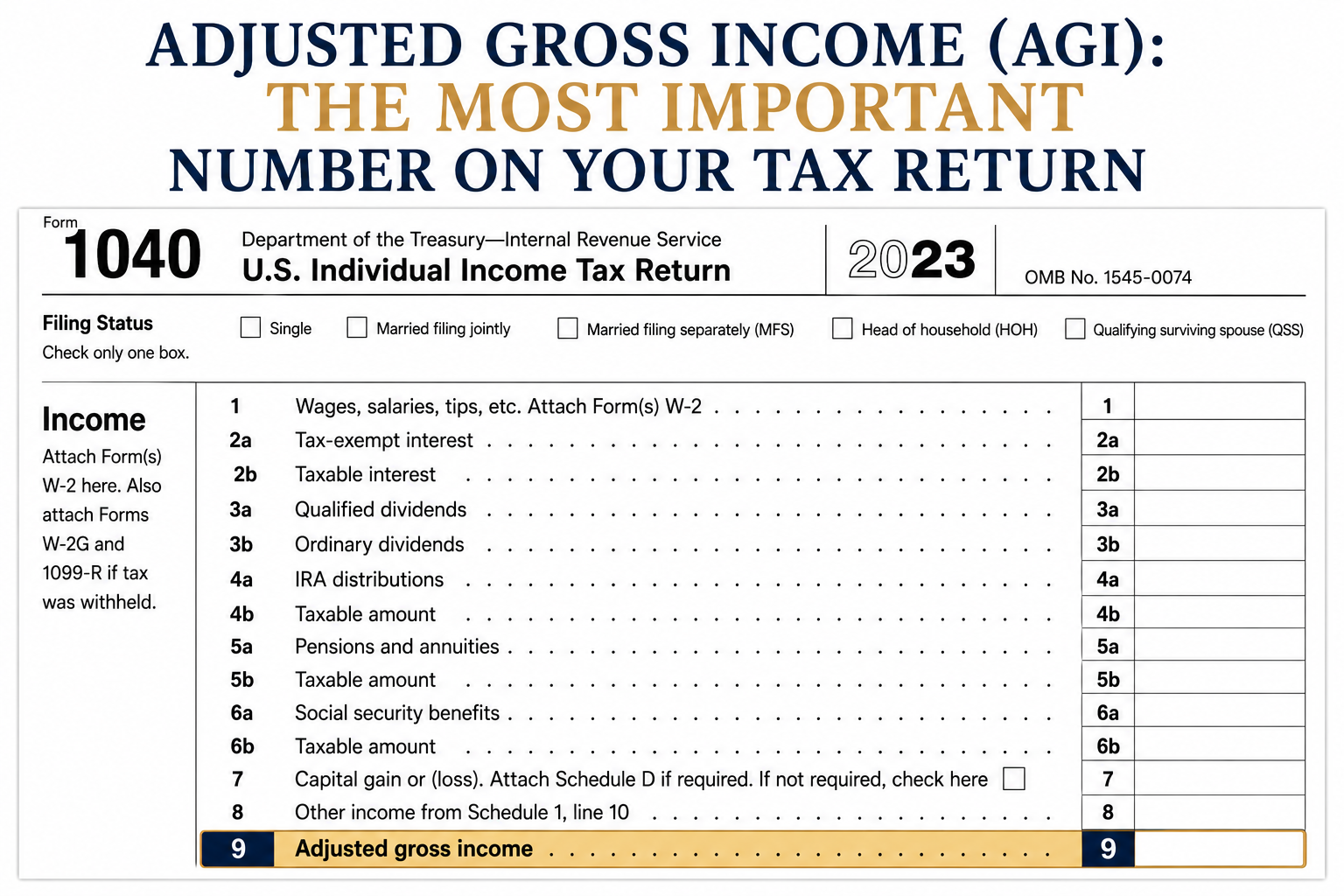
Adjusted Gross Income (AGI): The Most Important Number on Your Tax Return
Why Every Retiree Should Know Their AGI
Most retirees know their investment balances.
Many know their Social Security benefit.
Few know one of the most important numbers on their tax return:
Adjusted Gross Income (AGI).
If you only tracked one number each year to help improve your retirement tax strategy, AGI would be near the top of the list.
What Is Adjusted Gross Income?
Adjusted Gross Income is your total income after certain adjustments but before either the standard deduction or itemized deductions are applied.
You’ll find it near the bottom of the first page of Form 1040.
Think of AGI as the starting point for many tax calculations.
Why AGI Matters
Your AGI affects much more than your federal income tax.
It may influence:
- Medicare IRMAA premiums
- Taxation of Social Security benefits
- Eligibility for certain tax credits
- Roth conversion planning
- Capital gains strategies
- Charitable giving opportunities
- Overall retirement tax efficiency
A higher AGI can create a chain reaction throughout your tax return.
What Increases AGI?
Common sources include:
- Traditional IRA withdrawals
- Required Minimum Distributions (RMDs)
- Pension income
- Wages
- Interest income
- Taxable dividends
- Capital gains
- Roth conversions
Many retirees are surprised to learn that investment decisions can have a direct impact on AGI.
Why Retirees Should Monitor AGI
Imagine two retirees with similar investment portfolios.
One carefully manages withdrawals, Roth conversions, and investment sales.
The other withdraws money whenever needed without considering taxes.
Even if both earn the same amount, one may have a much lower AGI and keep more after-tax income.
That’s the difference between tax preparation and tax planning.
Common Mistakes
Ignoring AGI Until Tax Season
Many planning opportunities disappear once the year ends.
Reviewing AGI throughout the year provides greater flexibility.
Taking Large IRA Withdrawals
Large withdrawals can increase AGI and trigger higher Medicare premiums or additional taxation of Social Security benefits.
Selling Appreciated Investments Without a Plan
Capital gains increase AGI and may have ripple effects beyond the investment itself.
Waiting Too Long for Roth Conversions
Lower-income years often present opportunities to complete Roth conversions while managing AGI.
Point Wealth Insight
Many investors focus on investment returns.
We focus on after-tax outcomes.
Managing AGI isn’t about avoiding taxes—it’s about making informed decisions throughout retirement that may help you keep more of what you’ve earned.
Ask the Advisor
When reviewing your tax return, ask:
“How did my AGI change from last year, and why?”
The answer often reveals planning opportunities for the years ahead.
Continue Learning
- Form 1040 Line 3a vs. Line 3b: Why Qualified Dividends Matter
- Form 1040 Line 4a vs. Line 4b: IRA Distributions Explained
- Form 1040 Line 6a vs. Line 6b: Taxable Social Security Explained
- Medicare IRMAA Explained
- The Social Security Tax Torpedo
- Tax Diversification: Why Different Tax Buckets Matter
Sources
- Internal Revenue Service – Form 1040 Instructions.
- Internal Revenue Service – Publication 17: Your Federal Income Tax.
- Social Security Administration – Retirement benefits and taxation resources.
- Centers for Medicare & Medicaid Services – Medicare premium information.